
Commercial Kitchen Ventilation for Culinary Schools | Xinhuili Metal
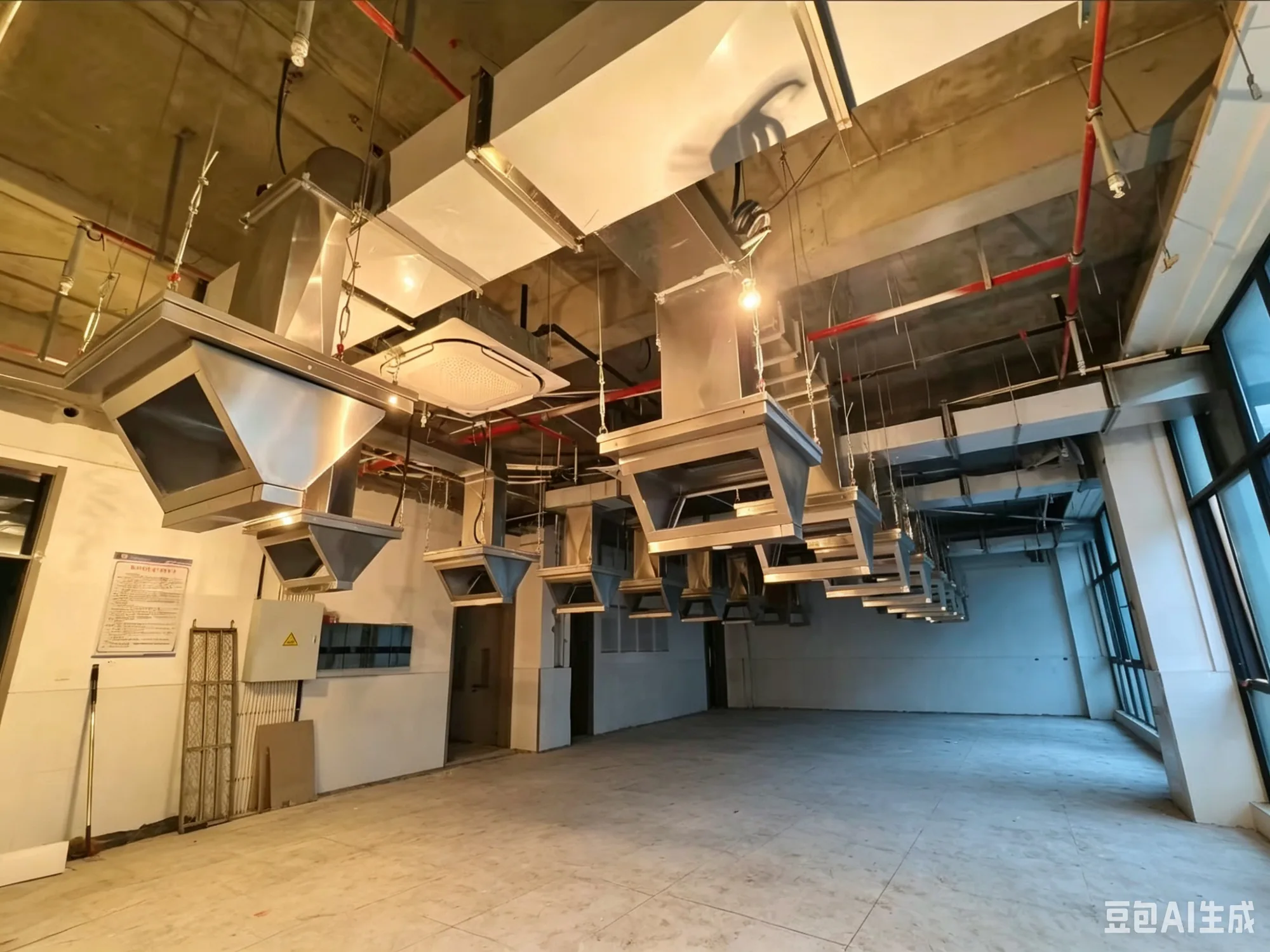
Commercial Kitchen Ventilation System for a Culinary School: 17 Island Hoods, 34 Cooking Stations

When a culinary school approached us to design and install their teaching kitchen ventilation system, the requirement was straightforward — and demanding:
34 students needed to cook simultaneously, at full capacity, without smoke, grease, or odour building up inside the kitchen.
This project called for a complete commercial kitchen exhaust and ventilation system — from the island hoods directly above each cooking station, all the way to the emission-compliant discharge point on the rooftop.
Here is how we engineered and installed it.
Indoor Installation: 17 Stainless Steel Island Hoods
The centrepiece of this commercial kitchen ventilation project is a row of 17 ceiling-suspended island hoods, fabricated entirely in SUS304 stainless steel.
Unlike wall-mounted canopy hoods, island hoods are suspended from the ceiling with no wall support, allowing students to access both sides of each cooking station. Each unit features dual-sided extraction — drawing smoke, steam, and grease-laden air from both faces of the hood simultaneously.
This dual-sided design means two students can work back-to-back at the same station, making island hoods the standard choice for high-density culinary school kitchens and professional cooking academies.
Indoor system specifications:
- 17 ceiling-suspended stainless steel island hoods
- Dual-sided extraction on every unit
- 34 active cooking positions in a single integrated system
- Full SUS304 stainless steel construction throughout hoods and ductwork
- Designed for simultaneous full-load operation
Outdoor Installation: Centrifugal Exhaust Fans + Electrostatic Precipitators
All mechanical components — fans and filtration units — are located outside the building, on the rooftop. This design eliminates mechanical noise from the kitchen and dining areas, and allows maintenance access without disrupting kitchen operations.
The outdoor installation consists of 4 groups of centrifugal exhaust fans, each paired with a dedicated electrostatic precipitator (ESP).

How the electrostatic precipitator works
Grease-laden exhaust air from the kitchen travels through the SUS304 ductwork to the rooftop units. Before discharge, it passes through the electrostatic precipitator, which uses high-voltage ionisation to attract and trap grease particles, oil mist, and combustion residue.
The result: exhaust air that is colourless, odourless, and emission-compliant — meeting near-ground emission standards for commercial kitchen exhaust in urban environments.
Outdoor system specifications:
- 4 groups of centrifugal exhaust fans
- 4 electrostatic precipitators (ESP), one per fan group
- Rooftop installation — zero noise impact on occupied floors
- Near-ground emission compliant discharge
- All outdoor ductwork in SUS304 stainless steel
Why SUS304 Stainless Steel Throughout — Including Outdoor Ductwork
All hoods, ductwork, and structural components in this project are fabricated from SUS304 stainless steel — including the sections installed outdoors.
Outdoor kitchen exhaust ductwork is exposed to:
- Rain and moisture ingress
- High-humidity air from the kitchen exhaust stream
- Grease condensation on duct walls
- Temperature cycling between seasons
SUS304 stainless steel provides the corrosion resistance to handle all of these conditions without surface coating, paint, or galvanising. The ductwork requires no protective treatment and maintains its structural integrity and appearance for the full service life of the installation.
For a culinary school — a facility where hygiene standards are taught as much as cooking skills — installing food-grade stainless steel throughout the exhaust system is the appropriate specification.